
Our Curriculum vision aims to emded our vision to make a difference and change lives for the better.
We aim to do this though our principles to Inspire Excellence, Challenge Potential and Empower Learning by ensuring the whole need of each child is met through a comprehensive programme that addresses their academic learning whilst also supporting those difficulties that arise from their autistic spectrum diagnosis.
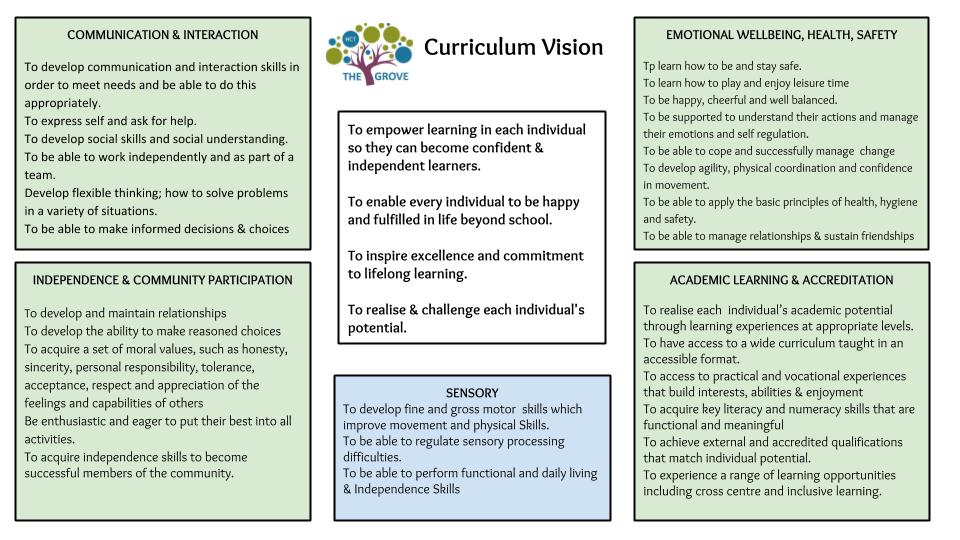
The Grove curriculum is person centered and tailored to the needs of our autistic learners. The curriculum offers pathways for students to learn from personalised programmes that address the needs and difficulties as outlined within the DSM-5 (Diagnostic and Statistical Manual of Mental Disorders, Fifth Edition). The DSM-5 identifies these areas as;
- a) Difficulties with social communication and interaction and;
- b) Restricted, repetitive patterns of behaviour, interests or activities (sensory behaviours are now included and recognised within this).
At The Grove we aim to realize our school vision through our curriculum by supporting our students to:
- Manage their autism through access to tailored programmes and therapeutic support;
- Have access to a wide curriculum taught in an accessible format
- Have access to practical, hands-on learning that build on their interests, abilities and enjoyment
- Develop meaningful key literacy and numeracy knowledge and skills.
- Achieve external and accredited qualifications that match each student’s’ potential.
- Acquire independence skills that prepare them for adulthood and successful participation in the community
Our aims will be achieved through the delivery of a broad and balanced curriculum
that is:
- Highly personalised and tailored to individual needs
- Flexible and responsive to each learner
- Differentiated and language-rich to support communication
- Age-appropriate and needs-appropriate
- Aligned with the National Curriculum where suitable for each student
- Focused on learning for life and developing independence
- Designed to offer meaningful qualifications and real-world experiences
- Enhanced through a multidisciplinary team working collaboratively
- Centred on Personal Learning Programmes (PLPs) linked to EHCP outcomes
- Culture-rich, including the promotion of key British Values
Organisation
The Grove curriculum is designed to meet the educational needs of our pupils, including the challenges that may arise from autism. Learning is practical, active and relevant to each pupil’s capacity and level of need. Pupils learn through hands-on experiences and consistent, structured teaching and learning opportunities that support the generalisation of skills.
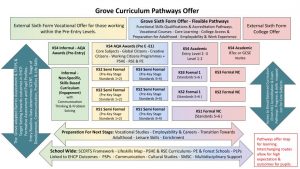
The curriculum is organised into the following pathways (see Fig. 1):
- Engagement Pathway
- Pathway 1
- Pathway 2
- Pathway 3
- Pathway 3+
Pupils follow the pathway that best matches their needs and level of attainment. Some pupils may work flexibly across two pathways where this best supports their learning and progress.
|
Engagement Curriculum |
Semi-Formal Curriculum | Formal Curriculum | |||
| Pathway 1
Pre-Key Stage Standards 1 & 2 |
Pathway 2
Pre-Key Stage Standards 3 & 4 |
Pathway 3
Pre-Key Stage Standards 5 & 6 (National Curriculum KS1) |
Pathway 4
National Curriculum KS2 |
Pathway 4 National Curriculum KS3 & KS4 |
|
| The Engagement Curriculum is delivered through relevant content and active learning approaches that promote pupil motivation and participation. It includes hands-on, practical activities that help pupils connect their learning to their own interests. The curriculum is informed by the five areas of the Engagement Model: exploration, realisation, anticipation, persistence and initiation. | The Pathway 1 & 2 Curriculum is delivered through a blend of subject-specific lessons and structured learning experiences. It focuses on developing key skills in communication and interaction, cognition and learning, social and emotional development, and sensory/physical needs. Subjects are taught discretely where appropriate to maintain the integrity of each discipline and to support clear, meaningful progress. | The Pathway 3 Curriculum follows the National Curriculum, delivered through a structured framework that supports the development of both knowledge and skills. The curriculum is carefully adapted to meet each pupil’s individual needs, ensuring learning is accessible and meaningful. Teaching is delivered through subject-specific lessons, providing a comprehensive and tailored learning experience. | Pupils in Pathway 3+ are working within the National Curriculum. Teaching is delivered through subject-specific lessons that are carefully adapted to ensure content is accessible, meaningful and appropriately challenging. The curriculum supports progress in academic learning alongside communication, independence and personal development, and prepares pupils for the accredited pathways offered at Key Stage 4.
At Key Stage 4, students continue to follow a broad and balanced curriculum that is adapted to their needs. Pupils work towards a combination of AQA Unit Awards, Entry Level qualifications, and GCSEs in core subjects, depending on their working level and individual targets. AQA Unit Awards are personalised and designed by the Curriculum & Assessment Team to capture each pupil’s strengths and achievements. |
||
|
Features of The Grove Semi-Formal Curriculum |
Features of The Grove Formal Curriculum |
||||
Semi-Formal curriculum includes:
|
Formal curriculum includes:
|
||||
|
Cycles |
|||||
|
|
|
|||
The Engagement Curriculum
A very small number of pupils are working within the Engagement Curriculum. Most are in the primary department and often progress into the Pathways 1 and 2 as their early learning skills develop.
The Engagement Curriculum is a broad, non-subject-specific curriculum designed to develop early foundational skills in:
- Communication
- Play and leisure
- Thinking and problem solving
- Independence
- Personal, social, health and emotional development (PSHE)
The emphasis is on preparing pupils for subject-specific learning within Pathways 1 & 2.
Learning is highly practical, motivating and structured, with teaching guided by the five areas of the Engagement Model:
- Exploration
- Realisation
- Anticipation
- Persistence
- Initiation
Targets are drawn from each pupil’s EHCP and broken down into personalised steps within their Personal Learning Plan (PLP). Formative assessment throughout the term informs PLP updates and reviews, ensuring teaching remains responsive to each pupil’s needs.
Pathways 1 &2
Pathways 1 and 2 provide a structured framework for developing the key skills that many autistic pupils may find more difficult to acquire naturally. These skills are fundamental to pupils’ overall development and form the foundations for future learning.
Pupils typically access Pathways 1 and 2 when they are developing an understanding of communicative intent and are beginning to express their needs, preferences and choices with an adult or peer. As these foundational skills strengthen, pupils become increasingly ready to engage with more formal and subject-specific learning.
Teaching within Pathways 1 and 2 is delivered through a blend of subject-specific lessons and carefully structured learning experiences. There is a strong emphasis on developing:
- Communication
- Social communication and emotional regulation, supported through identified transactional supports (SCERTS)
- Play and leisure skills
- Thinking and problem-solving skills
- Independence skills, including functional and life skills
- Early prerequisite skills required to access the National Curriculum
These pathways ensure that pupils acquire the essential skills needed to make meaningful progress and prepare for transition into Pathway 3 and Pathway 3+.
Pathway 3 and Pathway 3+
In Pathway 3 and Pathway 3+, pupils access the National Curriculum through subject-specific lessons that are carefully tailored to their needs, abilities and stage of learning. Programmes of study are based on the National Curriculum and are adapted where appropriate to ensure learning is accessible, meaningful and relevant.
Across these pathways, teaching continues to support areas of development that are recognised as particular challenges for autistic pupils. This includes the ongoing use of the SCERTS® framework to promote communication and emotional regulation, alongside a strong emphasis on life skills to support independence and preparation for adulthood.
Modern Foreign Languages/Cultural Studies
Modern Foreign Languages (MFL) and Cultural Studies are not delivered as part of the taught curriculum for all pupils. Instead, the approach to MFL is carefully designed to meet the developmental stage, needs and learning profiles of our pupils.
Where appropriate, pupils access cultural learning experiences that promote an understanding of the wider world, develop curiosity about other cultures, and support communication and social development in meaningful ways.
You can read more about MFL and Cultural Studies at The Grove here:
Statement for Modern Foreign Languages at The Grove
Life Skills & Independence Towards Adulthood
We aim for all pupils to develop the functional skills they need to lead fulfilling and increasingly independent lives. For autistic young people, everyday experiences provide valuable opportunities for learning, and our curriculum is designed to embed these opportunities throughout the school day.
Life skills and independence are integral across all curriculum pathways. Learning is delivered both within subject-specific teaching and through discrete life skills sessions, ensuring that pupils can practise and apply skills in meaningful, real-life contexts. Further information can be found in The Grove Life Skills Intent.
Specialist input from the Speech and Language Therapist, Occupational Therapist, and other professionals strengthens the delivery of life skills learning. These teams contribute to personalised programmes that support functional communication, sensory regulation and daily living skills.
Each pupil’s life skills pathway is shaped by:
- Their EHCP outcomes
- Their individual strengths and areas for development
- Multi-professional assessment, including input from families, staff, therapists and, where possible, the pupil
The Grove Curriculum provides extensive opportunities for pupils to develop life skills both on and off site. Key skills are integrated throughout the school day and reinforced through focused teaching sessions. We place strong emphasis on working in partnership with families to ensure learning is supported before, during and after the school day.
Progress within life skills learning is measured using an adapted AET Progression Framework, ensuring clarity, consistency and meaningful progression.
The Life Skills curriculum is structured around six key areas:
- My Social Self
- My Personal Care & Health
- My Safety
- My Play & Leisure Time
- My Independence
- My Travelling
You can read the full by clicking here.
Educational Health Care Plans (EHCP)
Every pupil attending The Grove has an Education, Health and Care Plan (EHCP). Each EHCP is reviewed annually through a Person Centred Annual Review, in which parents, carers and the pupil play a vital role in reflecting on progress and shaping future outcomes.
Personalised targets are derived directly from EHCP outcomes and form the basis of each pupil’s Personalised Learning Plan (PLP). The PLP breaks these outcomes into small, incremental steps and identifies the support required to secure meaningful progress.
Parents and carers are invited twice a year to Pupil Progress Meetings to review progress and agree the short-term targets within the PLP.
Progress towards EHCP outcomes is embedded across all aspects of the school’s curriculum and supported through the school-wide approaches outlined below.
| Cognition & Learning |
|
| Communication & Interaction |
|
| Social, Emotional & Mental Health |
|
| Physical & Sensory |
|
| Self Help & Independence |
|
Personalised Support Plans
Each pupil at The Grove has a Personalised Support Plan (PSP) that outlines the resources, strategies and approaches the school will use to support their individual outcomes. The PSP provides a clear overview of how the pupil will be supported throughout the school day.
The PSP includes the following key sections:
- Pupil Pen Portrait
- Pupil Wellbeing Plan (including mental health support)
- Transition Towards Adulthood Plan (from Year 9 onwards)
PSPs are written in consultation with the school’s multi-disciplinary team and pastoral team, ensuring that each plan reflects a comprehensive understanding of the pupil’s needs and the support required to help them thrive.
Further Information about our Curriculum
If you would like further information about our school curriculum you can contact our Curriculum Lead: Helen Georgiades, Deputy Headteacher: helen.georgiades@thegroveschool.co.uk
